KEY TAKEAWAYS
- A 30-year comparison is a scenario, not a prediction; condition depends on construction, maintenance, governance and local conditions.
- Compare total ownership costs, reserves, land entitlement, utilities, water and resale evidence—not only launch price or floor area.
- Project figures are company-provided; verify them and obtain independent legal and financial advice.
This article is published by Stonecraft Group. Project-specific figures and comparisons are company-provided and have not been independently audited here. Verify current project records, approvals and legal documents before relying on them. Illustrative comparisons do not predict performance or guarantee investment returns.
Executive Summary: Over a 30-year ownership horizon, high-density luxury skyscrapers and nature-integrated horizontal estates follow opposite financial and physical trajectories. By Year 30, a vertical concrete tower confronts finite engineering lifecycles across plumbing stacks, curtainwall glazing, and structural cores - triggering steep capital expenditure assessments, homeowners' association gridlock, and near-impossible redevelopment hurdles across thousands of fractional owners. Conversely, a density-controlled biophilic estate like Woods Shamshabad by Stonecraft Group experiences biological compounding: 4,50,000+ Miyawaki trees mature into a self-cooling forest canopy, deep aquifer percolation trenches stabilize groundwater tables, mycorrhizal soil networks sustain 150+ native plant species, and low-density acreage along the Nehru Outer Ring Road (ORR) becomes irreplaceable generational wealth.
The Day-One Illusion vs. The Year-30 Reality
In Indian luxury real estate, almost every purchasing decision is made through the lens of Day One. Buyers walk through freshly polished show flats, admire pristine double-glazed glass facades, and inspect newly commissioned clubhouses. On the day of handover, a ₹15 crore high-rise sky villa and a ₹15 crore landed forest estate may appear equally prestigious on a family balance sheet.
Family offices and generational wealth architects, however, do not underwrite residential assets for Day One; they underwrite them for Year 30.
Every piece of real estate consists of two distinct components that age in opposite directions: synthetic mechanical infrastructure, which begins depreciating the moment it is commissioned, and sovereign living earth, which appreciates in scarcity and ecological maturity with every passing decade. True luxury isn't an asset that ages into obsolescence - it’s a biological bond that compounds over time.
Year 30 in a High-Density Concrete Tower: The Four Traps of Obsolescence
When a 45-to-55-storey luxury tower in West Hyderabad reaches its third decade, the initial glamour of vertical living collides with structural physics and collective governance realities. High-net-worth families holding aging sky villas face four compounding liabilities:
1. Finite Engineering Lifecycles on Cores, Stacks, and Glazing
Modern skyscrapers are complex machines with hard mechanical expiration dates. By Year 25 to Year 30, vertical plumbing and drainage stacks embedded within concrete shear walls suffer from scale buildup, joint fatigue, and concealed seepage. High-speed elevator traction systems require complete cabin and shaft modernization. Most critically, floor-to-ceiling structural glazing - exposed to 30 years of intense Deccan solar radiation and monsoon wind loads - experiences elastomeric sealant failure and gas-fill depletion, turning once-insulated glass facades into leaky thermal bridges.
2. Steep Capital Expenditure (CapEx) Assessments
Statutory sinking funds collected during the early years of an apartment complex rarely keep pace with thirty years of construction inflation. Re-cladding a 50-storey glass facade, waterproofing multi-level subterranean basements, and replacing central HVAC chillers or sewage treatment plants require massive one-time capital calls. Owners find themselves paying lakhs or crores in special assessments simply to arrest the physical decline of common areas they do not individually control.
3. Association Governance Gridlock
In a mega-project housing 1,500 to 3,000 families, resident profiles diverge sharply over three decades. Original buyers relocate, units transition into rental inventory, and multi-generational heirs inherit fractional shares. Passing resolutions for major structural upgrades inside a Resident Welfare Association (RWA) of 2,000+ households routinely stall in consensus paralysis, deferred maintenance, and litigation over cost-sharing formulas.
4. The Redevelopment Deadlock
Historically, older 4-to-5-storey apartment buildings in Indian cities could be demolished after 30 years and redeveloped by a builder utilizing higher Floor Space Index (FSI) to fund new construction. When a tower is already built to 50 storeys at maximum FSI with 100 to 160 families per acre, there is no leftover FSI headroom to make redevelopment financially viable. Securing legal consent across 2,500 fractional Undivided Share of Land (UDS) holders while financing the demolition of a 500-foot reinforced concrete core is virtually impossible.
30-Year Asset Lifecycle Comparison: Concrete Towers vs. Forest Estates
| Lifecycle Dimension | Year 30: High-Rise Tower | Year 30: Standard Villa | Year 30: Woods Shamshabad | Issues to Verify Over Time |
|---|---|---|---|---|
| Primary Infrastructure | Condition depends on inspection and upkeep | Condition depends on materials and exposure | Forest condition requires current records | Compare maintenance and ecological records |
| Thermal Efficiency | Energy use depends on design and maintenance | Energy use depends on design and shade | Measure site-specific canopy and energy use | Use comparable measured energy data |
| Water Security | Check sources and long-term supply | Check sources and long-term supply | Verify current water and recharge records | No water-security outcome is guaranteed |
| Governance Model | Review association size and repair reserves | Review association rules and costs | Verify title and governance documents | Compare enforceable rights and obligations |
| Land Entitlement | Verify registered land share | Verify registered plot area | Verify registered plot area | Confirm title and approved boundaries |
As the 30-year projection demonstrates, the financial divergence between vertical condominiums and nature-integrated estates is structural. While high-rise owners fund escalating maintenance to slow down mechanical decay, forest landowners watch nature perform free infrastructural upgrades year after year.
Year 30 on Density-Controlled Forest Land: The Compounding Biological Bond
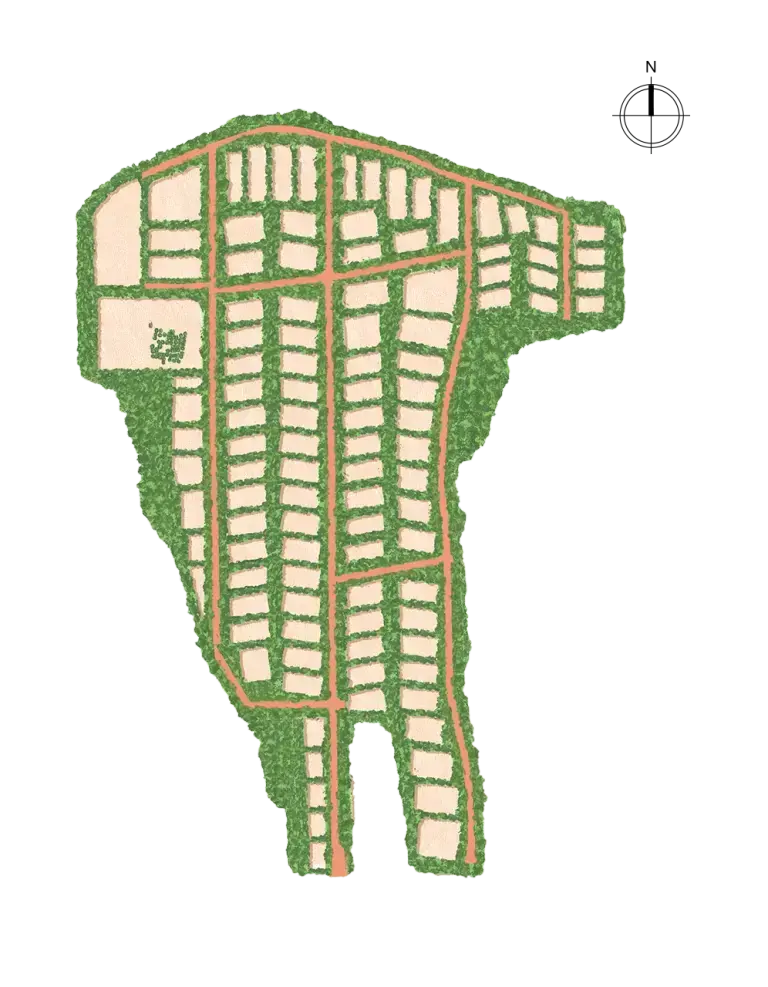
What happens when you replace depreciating concrete podiums with regenerative ecological engineering? At Woods Shamshabad, Stonecraft Group’s flagship 60-acre development near Hyderabad’s Rajiv Gandhi International Airport, the master plan was architected so that Year 30 represents the estate's ecological and financial prime.
By restricting 60 acres to just 110 luxury plots (~1.83 families per acre), Woods Shamshabad harnesses five self-reinforcing natural systems that grow stronger across decades:
A Mature Old-Growth Canopy: Planted using the accelerated Japanese Miyawaki afforestation method, the estate’s 4,50,000+ native trees reach complete multi-tiered forest maturity long before Year 30. Interlocking upper canopies cast continuous deep shade over residences and internal pathways, delivering passive microclimate cooling that reduces ambient summer temperatures by up to 4°C and permanently lowers household HVAC loads.
Hydrological Self-Reliance: While urban corridors face severe borewell depletion over a 30-year cycle, Woods Shamshabad is engineered with deep aquifer percolation trenches, rainwater harvesting swales, and natural water bodies across more than 82% permeable soil. Three decades of captured monsoon runoff create a stabilized, self-replenishing underground water table that insulates the community from municipal water crises.
Living Soil and Mycorrhizal Regeneration: Beneath the forest floor, decades of natural leaf-litter decomposition cultivate a thriving mycorrhizal fungal network connecting the roots of 150+ native plant species and 70 rescued Hyderabad Secretariat heritage trees. This underground biological internet transfers nutrients, retains soil moisture, and keeps the landscape self-sustaining without synthetic fertilizers or heavy water consumption.
Living Botanical Perimeters: Whereas masonry compound walls crack, spall, and radiate heat over 30 years, the zero-masonry living tree buffers framing every plot at Woods Shamshabad thicken into impenetrable botanical walls. These living perimeters sequester hundreds of tonnes of carbon, filter airborne particulate dust, and absorb low-frequency highway and aviation noise.
Irreplaceable Transit-Corridor Scarcity: Over a 30-year metropolitan expansion cycle, peripheral farmland surrounding major highways is inevitably rezoned into high-density commercial and residential blocks. Controlling 1,800 to 3,500+ square yards of covenanted, low-density forest land right along the Nehru Outer Ring Road (ORR) corridor secures a spatial monopoly that can never be replicated at any price.
Furthermore, because each family holds full title to their plot, upgrading or remodelling an individual residence in Year 30 requires zero permission from thousands of neighbours. The architecture can evolve effortlessly across generations while the surrounding 60-acre forest remains intact.
The Stonecraft Group Portfolio: Generational Heirlooms Across Every Life Stage
Guided by the conviction that real estate must grow richer with every passing generation, Stonecraft Group applies its nature-integrated engineering philosophy across four distinct residential asset classes in Hyderabad:
Woods Shamshabad (60-Acre Flagship Forest Estate): Situated in South Hyderabad near RGI Airport and the ORR, the world’s largest residential Miyawaki forest offers 110 ultra-low-density plots (1,000 to 5,000 sq. yds.) buffered by 4,50,000+ native trees and 141+ documented bird species.
Woods Indresham (32-Acre Biophilic Villa Plot Community): Located along Northwest Hyderabad’s fast-appreciating Patancheru–ORR growth corridor, Woods Indresham brings density-controlled plotted living, native afforestation, and hydrological sustainability to families seeking long-term land appreciation alongside West Hyderabad’s employment hubs.
Woods Banjara Hills (Boutique Nature-Integrated Urban Living): Designed for ultra-discerning families who require an address in Hyderabad’s most prestigious central postcode without sacrificing biophilic tranquility, Woods Banjara Hills integrates mature greenery, breathable architecture, and boutique privacy within the city core.
Stonecraft Nirvana (Nature-Integrated Senior Living): Recognizing that human longevity thrives in clean air, acoustic peace, and barrier-free natural surroundings, Nirvana reimagines senior living as a restorative sanctuary—combining specialized medical and wellness infrastructure with therapeutic green spaces.
Across every project, the underlying thesis remains constant: concrete ages, but a thoughtfully engineered ecosystem compounds.